ORIGO: Deep-Time Ancestral Atlas
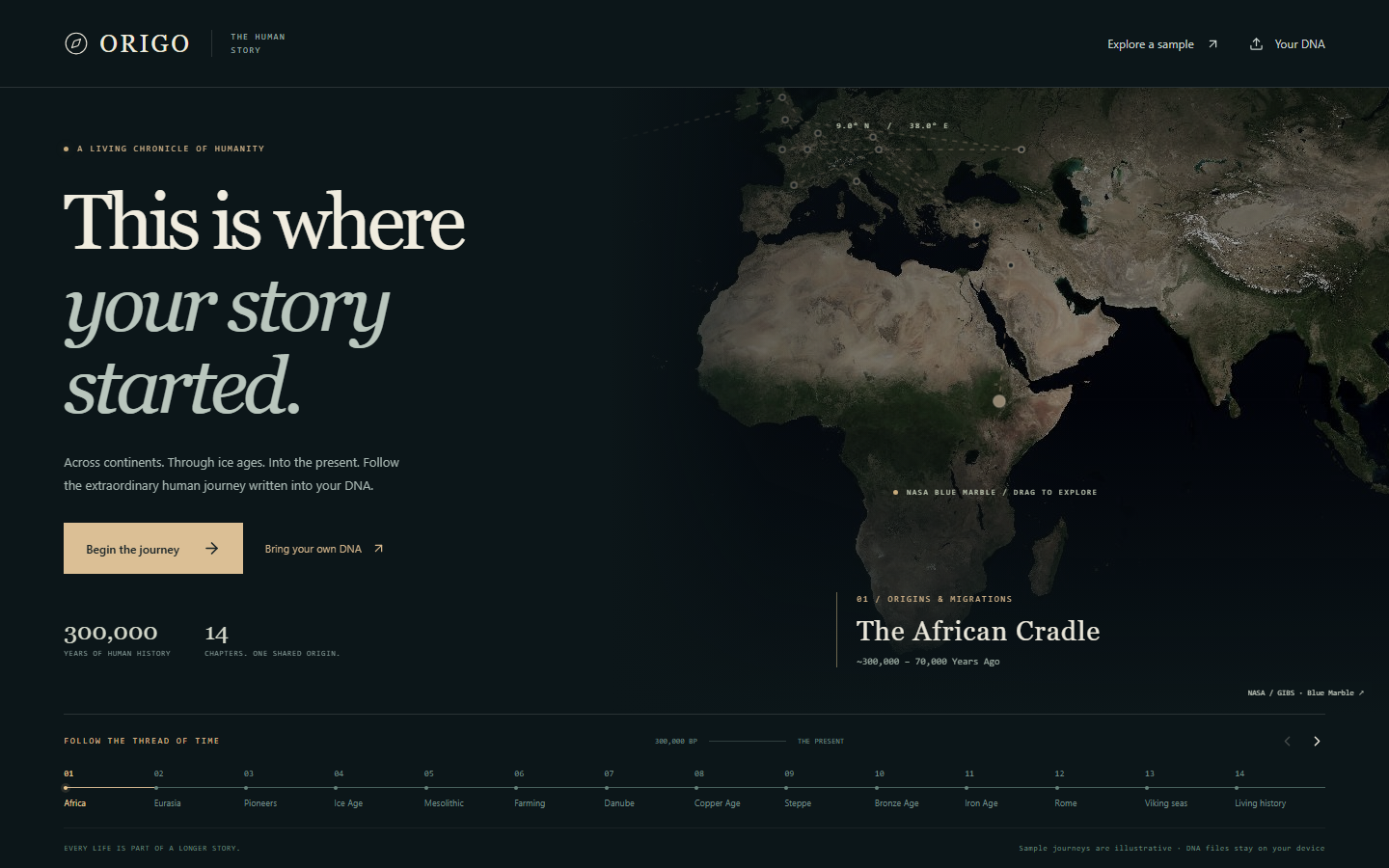
An in-browser bioinformatics engine and 4D geospatial atlas that transforms raw consumer genomic variant files into an interactive chronicle tracking 300,000 years of human evolutionary dispersal.
Scientific Vision & In-Browser Genomics
Traditional commercial genetic genealogy presents ancestry as static, flat pie charts and isolated regional percentages (e.g., "42% Northwestern European"). ORIGO transforms raw consumer genomic data into a four-dimensional journey across 300,000 years of evolutionary history, charting ancestral survival corridors from archaic speciation in Africa through the Last Glacial Maximum and Neolithic agricultural expansions into the modern era.
Genomic variant arrays contain intensely sensitive, unchangeable health and identity data. ORIGO is architected so that raw files are decompressed, parsed, and queried completely inside browser memory using pako and typed arrays. No genomic data is ever uploaded to a remote server.
Core Subsystems & Scientific Pipeline
1. Universal Genomic Parser (`universalParser.ts`)
Detects, decompresses, and normalizes disparate raw DNA formats directly in client RAM:
- 23andMe: Build 37 and Build 38 tab-delimited formats.
- AncestryDNA: Commented TSV/CSV format with multi-allele parsing.
- Standardized VCF / gVCF: In-memory gzip decompression via
pako. - Normalization Pipeline: Extracts
rsID,chromosome,position, andgenotypeinto indexed typed arrays for instant O(1) hash lookups.
2. Phylogenetic & Admixture Engine
Resolves paternal Y-DNA haplogroups (A00 down through R1b-M269, I1-M253, E1b1b, J2, and Q-M242) and maternal mtDNA (L0 through H, U, K, J, T, and Indigenous American clades). Incorporates an Archaic Introgression Resolver that screens against ancient Vindija Neanderthal and Altai Denisovan genomes to compute inherited archaic traits (such as high-altitude EPAS1 mutations).
3. Interactive 4D WebGL Migration Globe
Powered by Three.js and React Three Fiber, the 3D globe renders geological ice sheet overlays, continental shelf exposures during glacial maximums, and dynamic geodesic migration arcs. Players scrub through 4D time slices from 300,000 BCE to 1900 CE.
4. Evidence Workbench & Archaeological Benchmarking
Every historical migration vector is grounded in peer-reviewed archaeogenetics. The Evidence Workbench links genetic mutations directly to radiocarbon-dated excavation sites and landmark papers published in Nature, Science, and Cell via persistent DOI links.
Bioinformatics & Graphics Stack
| Component | Technology | Role in Engine |
|---|---|---|
| Frontend Core | React 19, TypeScript 7, Vite 8 | Strict type definitions across genomic coordinate datasets |
| 3D Geospatial Engine | Three.js 0.185+, React Three Fiber, Drei | 60 FPS WebGL planetary shader rendering & time scrubbing |
| State Management | XState v5 (xstate 5.32+) | Finite state machine governing parsing and temporal playback |
| Decompression Engine | pako (in-browser gzip) | Streams compressed .vcf.gz into memory without disk writes |
| 2D Cartography & Scales | Leaflet 1.9, D3-Scale | Linear and logarithmic timeline interpolation |
| Genomic Alignment | GRCh37 / GRCh38 ISOGG Tables | Standardized SNP coordinate mapping against reference assemblies |